- New Money
- Posts
- Unshaken
Unshaken
Sell... or stay? Here’s exactly what to do when the market drops.

Angelo Castillo
February 23, 2026

Happy Monday,
Angelo here! Welcome to New Money, where we go over weekly tips to help you build your wealth, one dollar at a time.
Today’s edition:
How crashes actually build wealth
The crash pattern you should understand
Meta expansion, Bitcoin outflows, and more…
Read time: 2 min 40 seconds
🍎Wealth Tip of the Week
At some point in your investing life, the market will drop.
Not maybe. Not possibly. It will.
And when it does, nobody will send you a calm, reassuring email.
Instead, the headlines will start getting dramatic. Your friends will text you asking if they should sell. Your social media feed will suddenly be full of “experts” predicting the end of the economy. And when you open your portfolio, it’ll be bleeding red.
And you’ll be forced to make a decision:
Sell… or stay.
This is where wealth changes hands.
Here’s how to be on the right side of it.
1. Understand the Pattern
Every crash feels different when you’re living through it. But zoom out far enough, and the pattern is always the same.
Over the past 150 years, there have been 19 major bear markets. Some were mild, some completely devastating.
The Great Depression wiped out 79% of the market. The 1970s inflation crisis cut stocks in half. The dot-com bust and financial crisis dragged on for over a decade.
The causes are always different, but the structure is the same.
Here’s how it plays out (almost) every time:

Phase 1: Euphoria.
This is when everything feels easy. Stocks keep going up. Everyone suddenly has an opinion about investing. Your group chat is talking about which stock is "next." It feels obvious. It feels safe and you actively feel the FOMO creep in with every post about a “10x return” you see on your for you page.
Phase 2: The crash.
Then reality kicks in. Prices start falling. The news gets dramatic. People start panic. You open your portfolio and it's red… again. What felt safe a few months ago suddenly feels terrifying. Anxiety, denial, panic, then anger. Waves of emotions until you reach a tipping point to where you enter extreme fear and panic sell.
Phase 3: Recovery.
Slowly and usually when most people least expect it, things start turning around. The panic fades. Prices start climb back, yet you are in disbelief that the worse is behind you. And eventually, things start to level out and you are back to phase 1.
The only thing that changes is how long each phase lasts.
2. Build Cash
The first thing you need to do is strengthen your position. That starts by cutting back on things you don’t need.
Here's what always happens: During the crash, prices drop. During the recovery, smart investors who saved cash get to buy everything on sale.
In 2008, people who had cash sitting on the sidelines bought stocks at 40-50% discounts. Four years later, those investments had doubled.
When your favorite store has a sale, you want cash in your pocket. Same thing here.
Every dollar saved today, is ammunition to buy your wealth tommorrow.
So during uncertain times, focus on strengthening your base:
Trim unnecessary expenses
Pause upgrades and impulse buys
Make sure your emergency fund is solid (3–6 months minimum)
Keep extra cash in a high-yield savings account so it’s earning something while you wait. 👉 Start earning here
Recessions reward people who have flexibility. Cash gives you options. And options create opportunity.
3. Keep Investing
When your portfolio is down 20%, your instinct is to “stop the bleeding.” That’s normal.
But here’s what history shows over and over again:
The biggest up days in the market usually happen right after the biggest down days.
If you panic-sell during Phase 2, you almost guarantee you’ll miss Phase 3.
But if you panic-sold and missed just the 5 best trading days, you'd only have $671,000.
If you miss 50 best days, you're down to $76,000.
The difference between $1 million and $76K is panicking at the wrong time.
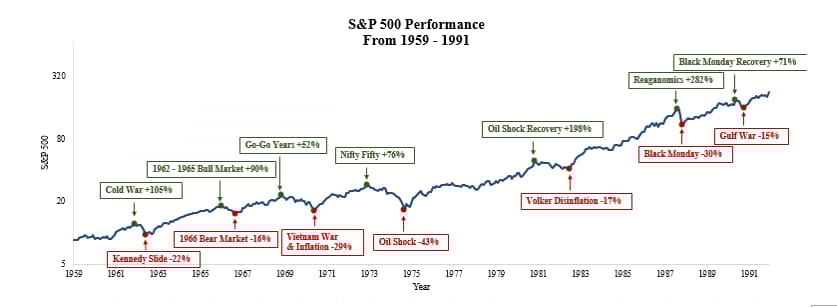
That growth didn’t happen smoothly. It happened through recessions, crashes, wars, inflation, and panic.
That’s why I keep investing. You only reach it if you stay in the game.
Here’s another trick:
If you struggle with emotions to do this manually when everything's red, the simplest solution is automation. Set the same amount every month and take the emotion out of it.
Here is a link to a tutorial I made on how to do so.
4. Stay Calm
The hardest part of investing isn’t picking stocks. It’s controlling your emotions during the crash.
You can’t control the Fed. You can’t stop the market from dropping 30%. You can’t silence the headlines.
The only thing you can control is whether you panic. And that’s genuinely hard.
When thousands of dollars disappear from your portfolio, every instinct wants to hit “sell all.”
But here’s something wild: Fidelity once found that some of their best-performing accounts belonged to people who were either dead or forgot their passwords.
They beat active traders because they couldn’t panic-sell during Phase 2.
And the pattern keeps repeating:
Phase 2 (The Crash):
Typically lasts about 9–10 months on average, and during that time it feels painful, everything is red, and it can seem like it will never end.Phase 3 (The Recovery):
Phase 3 lasts about 2–3 years on average, during which the market rebuilds and eventually pushes past its old highs.
If you look at what’s happened in past crashes, the story is always the same.
2008: The market crashed. People panicked. Given some time, the market eventually fully recovered and moved even higher.
2020: The market dropped 34% in a month. By the following year, new all-time highs.
If you can hold through less than a year of pain, you get multiple years of gains.
Recessions don’t destroy wealth. They transfer it. The market will drop again in your lifetime.
That’s guaranteed. But so is recovery.
The only question is: will you still be invested when it does?
Hit reply and tell me what you're doing during the market crash.
Where are you right now in your financial journey? |
💬Quote of the Week
Between stimulus and response there is a space. In that space is our power to choose our response. In our response lies our growth and our freedom.
📉 Market Recap
Check out some of the biggest stories shaking up money, markets, and momentum this week.
The Fed is pressing pause on rate cuts as it watches inflation closely
Meta is betting heavily on AI as it continues to buy more chips from Nvidia
Berkshire invests $350M in New York Times while trimming Apple and Amazon
Bitcoin ETFs bleed $133M in outflows as market fear deepens
I want your honest take! Are you enjoying the market recap? |

As of 02/20/2026
👀 In Case You Missed It
If you want to be rich, watch this before you obsess over the wrong things.
🌱3 more ways I can help build your wealth
Budget Template + Net Worth Tracker: Most budgeting apps either baby you or confuse you. This template does neither. It gives you clarity in under 10 seconds a day. I use it to track spending, savings, and net worth in one place.
My Youtube Channel: If you prefer learning visually, I walk through real-life examples, portfolio breakdowns, and beginner-friendly concepts step by step so they actually make sense.
Quick Survey (Help Me Help You): The more I understand you, the better I can guide you. It only takes 2 minutes to fill this out so I can help you create structure and build wealth with confidence.
P.S. My goal is to help you create structure around your money. When you automate the basics and know your numbers, managing your finances gets easier and building wealth feels less overwhelming.
See y’all next week 🫡
- Angelo Castillo
How did you like today's newsletter? |
Disclaimer: The content of this newsletter is for informational purposes only and should not be construed as investment, legal, or tax advice. The views and opinions expressed herein are solely those of the author and do not necessarily reflect the views of any business, employer, or other entity. Investing involves risks, including the potential loss of principal. Past performance does not guarantee future results. Readers are advised to conduct their own research and consult with qualified professionals before making any investment, legal, or financial decisions. The information provided is believed to be accurate but cannot be guaranteed. The author and publisher disclaim any liability for actions taken based on the content of this newsletter. This newsletter is not an offer to buy or sell any security. By subscribing or continuing to read this newsletter, you acknowledge and accept these terms and conditions.
Some of the links are my affiliate links. If you click on these links and sign up/purchase something, I may earn a small commission at no additional cost to you. This helps support me and allows me to continue creating content for you. I only promote products and services I genuinely believe in. Thank you for your support!