- New Money
- Posts
- Now
Now
$5 turned into a six-figure portfolio... here’s what happened

Angelo Castillo
March 25, 2026
Happy Wednesday,
Angelo here! Welcome to New Money, where we go over weekly tips to help you build your wealth, one dollar at a time.
Today’s edition:
How $5 turned into six figures
The real power of compounding
Oil rising, rates staying high, and more…
Read time: 2 min 50 seconds
🍎Wealth Tip of the Week
When I was 18, I sold a Lilo & Stitch bubble blower on eBay for $5 profit.
I bought it at a garage sale for a dollar. Listed it online. Went to bed. Woke up to a sale.
Five bucks. Barely enough to buy lunch.
But that $5 sale set off a chain reaction that would turn into $200,000 in sales by the time I was 20.
That one small moment sparked curiosity. And over time, that curiosity started to compound.
This week, I'm breaking down how compounding actually works and why the boring, tiny decisions you make today matter more than you think.
The Power of Compounding
Most people think compounding only applies to money. It doesn’t.
It shows up in three places:
Financial compounding – how your money grows
Cognitive compounding – how your skills stack
Consistency – what makes both work
Let’s start with money.
1. Financial Compounding
That $5 didn’t stay $5.
It turned into garage sale flips, then thrift stores, then selling books on Amazon, and eventually a textbook business.
By age 20, that snowball turned into $200,000 in sales. It wasn’t one big jump. It was small steps stacking over time.
At some point, I started asking a bigger question: what do I do with the money I’m making?
So I started looking into investing. I read, watched videos, and tried to understand how the game actually works. That’s when I came across a simple example that changed how I think about money:
Two people invest the same amount every year. One starts earlier, the other starts later.
Person A starts at 20 → ends with $1.77M at 65
Person B starts at 25 → ends with $1.28M at 65
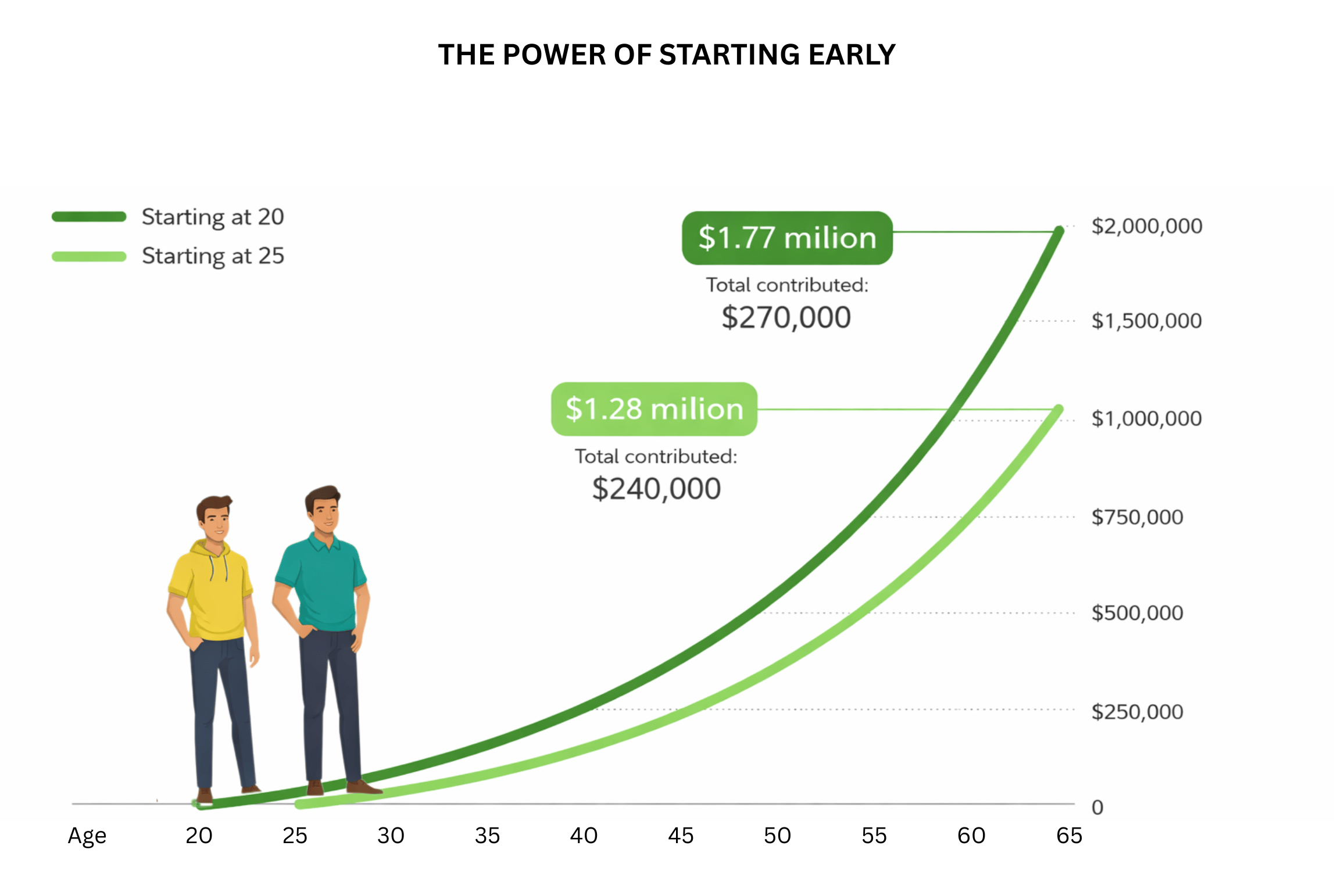
This example assumes $6,000 invested per year with an average annual return of 7%. It does not include taxes, fees, or inflation, which may lower actual results. Returns are not guaranteed and investing involves risk.
Time matters more than how much you invest. Starting early is one of the biggest factors in long-term investment growth, even more than how much you invest.
I didn’t need to be perfect. I just needed to start. So I set up automatic investments even when I barely had money. I forced myself into the game.
Money left my account every month whether I made it or not. That pressure made me figure things out.
Once you start investing, you need to stay informed. A tool that I recently starting using for this, is Investing Pro. It helps me monitor market trends, check how my investments are performing, and access tools that help me see what different investment strategies could look like over time. When it comes to building wealth, these are “expenses” are actually investments into my skills myself.
Here is my referral code with an extra 15% off (55% off in total!)
2. Cognitive Compounding
When COVID hit, my business disappeared almost overnight. I lost income, momentum, and direction all at once.
So I tried everything from day trading, dropshipping, running an agency. None of it worked. I lost money and felt like I was back at zero.
But looking back, that wasn’t true. Every failure taught me something. I became better at spotting bad opportunities, making smarter decisions, and knowing what to avoid. Over time, those lessons started to stack.
That’s cognitive compounding. You’re not starting over, you’re starting from experience. So I went back to what worked.
I started selling books again, then slowly expanded. By the end of the year, I was back to $200,000 in sales. All because I was willing to start small again but this time, I was better.
There’s a concept by James Clear that I always come back to: If you get just 1% better every day, you’ll end up dramatically better over time.
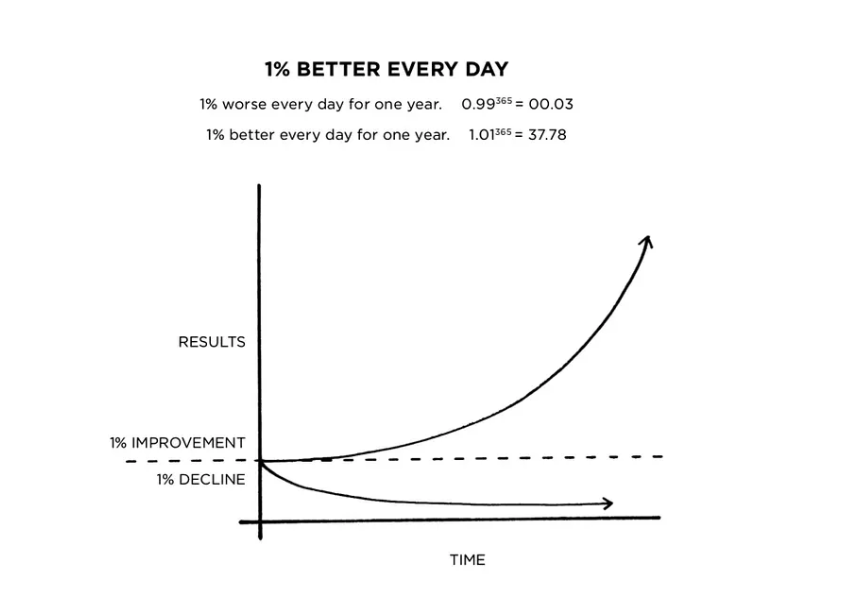
It doesn’t feel like much at the moment. But those small improvements build on each other until you’re operating at a completely different level.
Here’s a simple way to apply it:
Extract the lesson immediately - After anything fails, write down one thing you learned. Keep it simple.
Apply it to your next move - Don’t jump to something completely new. Use what you just learned to improve your next attempt.
Stack your knowledge - Stick to one direction long enough for your skills to build on each other.
3. Stay Consistent
This is where most people struggle.
Compounding feels slow at the start. Progress looks small, and results take time. So people quit too early.
But compounding only works if you stay in the game long enough to see it.
Most people don’t fail because they’re wrong. They fail because they stop too soon.
As Naval Ravikant puts it, all the returns in life come from compound interest—whether in money, relationships, or knowledge.
If you want compounding to work, make it easy to stick with:
Make it too small to fail. Start with something you can do even on your worst day. One listing. One hour. One task.
Remove decision-making. Automate what you can with investments, savings, even your schedule. Less thinking = more consistency.
Track your streak, not results. Focus on showing up daily instead of chasing outcomes. Results come later.
Expect it to feel slow. Nothing seems to happen at the start. That’s normal. That’s part of the process.
The people who win aren’t the smartest or the most talented. They’re the ones who stayed long enough for compounding to work.
You don’t need a big opportunity to build wealth.
Sometimes, it starts with something as small as $5.
Money compounds when you invest it, but your mindset is what keeps you in the game long enough to see results.
Put those two together, and over time, you turn small wins into real wealth.
What’s your version of that $5 moment? Hit reply
I read every response :)
Where are you right now in your financial journey? |
💬Quote of the Week
Set your mind on a definite goal and observe how quickly the world stands aside to let you pass.
📉 Market Recap
Check out some of the biggest stories shaking up money, markets, and momentum this week.
Oil stays above $100 as Middle East conflict escalates
U.S. strikes on Iran’s main oil export terminal, drone attacks shutting down UAE ports, and disruptions in the Strait of Hormuz (one of the world’s most important oil routes). Oil prices pushed above $100 and are expected to stay elevated as the conflict continues.
Wallet impact: Expect higher gas prices, more expensive flights, and rising costs for everyday goods. When oil stays high, almost everything becomes more expensive from groceries to deliveries.
Fed holds rates steady as uncertainty rises
The Federal Reserve kept interest rates unchanged at 3.5–3.75%, with Powell saying uncertainty is “elevated” due to the Iran conflict, rising oil prices, and mixed economic data. Rate cuts are still expected later this year but now likely delayed.
Wallet impact: Borrowing stays expensive. Credit cards, car loans, and mortgages won’t get cheaper anytime soon. If oil keeps pushing inflation up, rate cuts could be pushed even further which means higher costs stick around longer.
Mastercard bets $1.8B on crypto
Mastercard announced a $1.8B deal to acquire a company that powers stablecoin payments where digital dollars move on blockchain. Big players like Visa and Stripe are also moving in, as crypto and AI start to challenge traditional payment systems.
Wallet impact: Payments could become faster and cheaper over time (especially for sending money globally). But it also means the financial system is changing. Your future “banking” might look more like apps, crypto wallets, and digital dollars instead of traditional cards.
Google launches AI tool to turn ideas into apps instantly
Google released “Stitch,” a tool that can turn simple text or sketches into working app interfaces in seconds. You can describe an idea like “a food delivery app,” and it builds the design automatically using AI.
Wallet impact: This lowers the barrier to building apps and businesses. More people can create products faster, which means more competition but also more opportunities to earn online, freelance, or launch your own idea with less cost and technical skill.
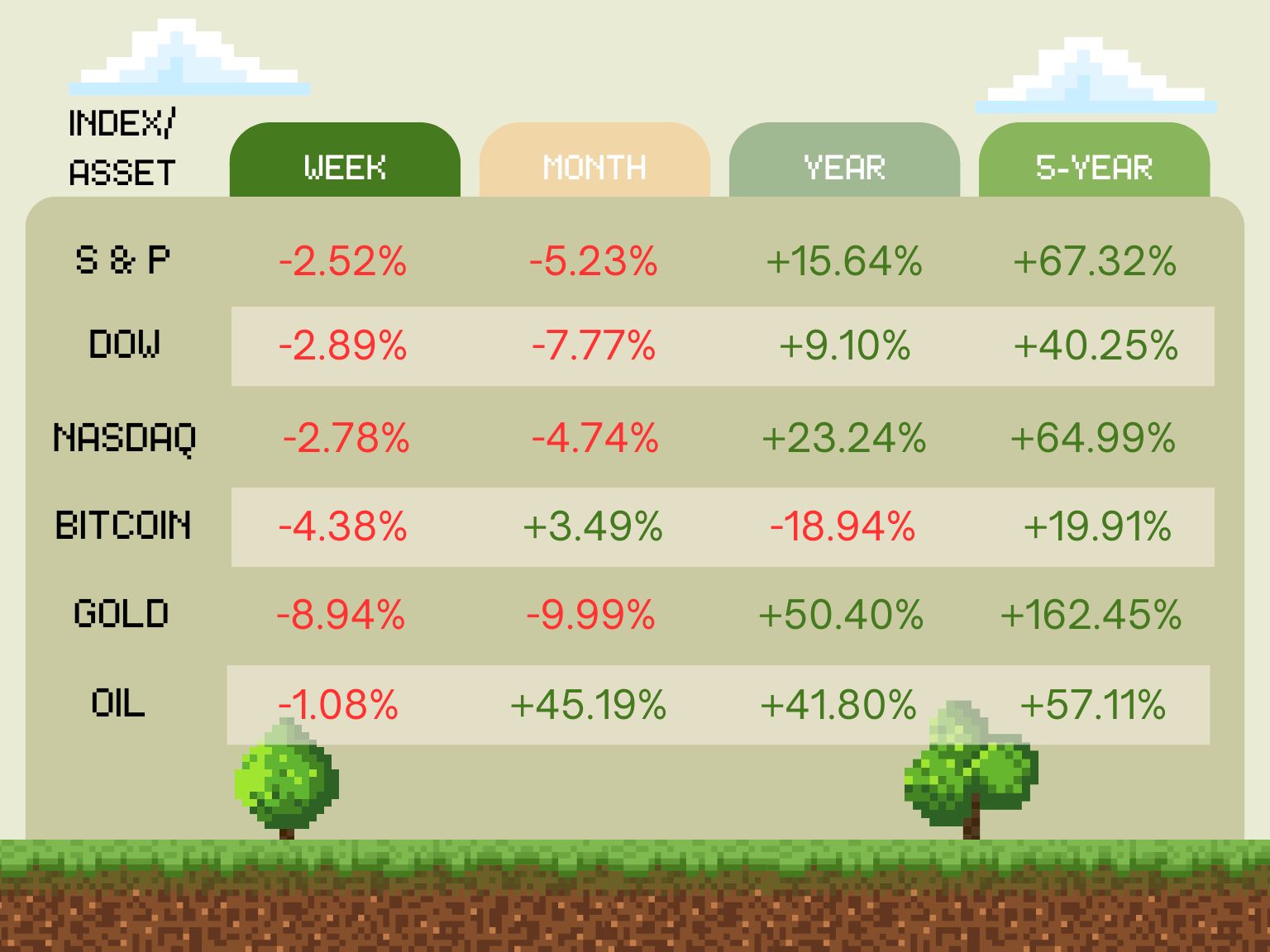
As of 03/19/2026
I want your honest take! Are you enjoying the market recap? |
👀 In Case You Missed It
If I had to start from $0 at 24, this is exactly what I’d do to hit $100K.
🌱3 more ways I can help build your wealth
Budget Template + Net Worth Tracker: Most budgeting apps either baby you or confuse you. This template does neither. It gives you clarity in under 10 seconds a day. I use it to track spending, savings, and net worth in one place.
My Youtube Channel: If you prefer learning visually, I walk through real-life examples, portfolio breakdowns, and beginner-friendly concepts step by step so they actually make sense.
Quick Survey (Help Me Help You): The more I understand you, the better I can guide you. It only takes 2 minutes to fill this out so I can help you create structure and build wealth with confidence.
See y’all next week 🫡
Angelo Castillo
How did you like today's newsletter? |
Disclaimer: The content of this newsletter is for informational purposes only and should not be construed as investment, legal, or tax advice. The views and opinions expressed herein are solely those of the author and do not necessarily reflect the views of any business, employer, or other entity. Investing involves risks, including the potential loss of principal. Past performance does not guarantee future results. Readers are advised to conduct their own research and consult with qualified professionals before making any investment, legal, or financial decisions. The information provided is believed to be accurate but cannot be guaranteed. The author and publisher disclaim any liability for actions taken based on the content of this newsletter. This newsletter is not an offer to buy or sell any security. By subscribing or continuing to read this newsletter, you acknowledge and accept these terms and conditions.
Some of the links are my affiliate links. If you click on these links and sign up/purchase something, I may earn a small commission at no additional cost to you. This helps support me and allows me to continue creating content for you. I only promote products and services I genuinely believe in. Thank you for your support!