- New Money
- Posts
- Blindspots
Blindspots
7 beginner investing mistakes I’d avoid if I started again today

Angelo Castillo
April 21, 2026

Happy Tuesday,
Angelo here! Welcome to New Money, where we go over weekly tips to help you build your wealth, one dollar at a time.
Today’s edition:
7 beginner investing mistakes (and what to do instead)
How to build a system you’ll actually follow
Oil drops, record highs, and more…
Read time: 3 min 20 seconds
🍎Wealth Tip of the Week
I once panic sold a stock that eventually went up over 1000%.
The stock was Palantir. None of it felt like a mistake when I was doing it.
That one mistake taught me more about investing than any video or course ever did.
And it’s just one of seven traps I fell into as a beginner before I even realized it.
Here are the seven traps I wish I saw earlier.
1. Waiting too long to invest
There is always a reason to wait.
The market feels too high. The economy feels uncertain. You tell yourself you’ll start when things settle down.
That’s exactly what I did. I kept thinking I just needed a better entry. A “safer” moment.
But that moment never came the way I expected. And while I was waiting, the market kept moving.
That’s the part I didn’t fully understand back then. Because every month you sit on the sidelines is a month compounding isn’t working for you.
A dollar invested at 22 is worth significantly more than a dollar invested at 32. That difference isn’t motivation. It’s math.
Looking back, I didn’t lose money here.
I lost time. And that’s the one thing you don’t get back.
And honestly, almost all of the advice here comes back to the same thing: start now.
Pick a simple amount and invest it this week even if it’s small. Then automate it so you don’t have to rely on motivation.
Most people avoid this step because it’s uncomfortable. But the number doesn’t get smaller because you ignore it. It just gets more expensive.
Also pull your credit report, there is a real chance something is on there you forgot about.
2. Being too scared of all-time highs
When the market is at an all-time high, most people assume a crash is coming and wait for a dip.
That’s what I did. I kept waiting for a “better” entry while the market kept moving higher.
The S&P 500 has finished the year positive roughly 73% of the time since 1928, according to historical market data going back nearly 100 years.
If you only invest when prices feel low, you’ll spend most of your time on the sidelines.
What worked for me was shifting from trying to time entries to just staying consistent.
The strategy that works is simple: Dollar cost averaging.

Set a fixed amount to invest every month and stick to it regardless of whether the market feels high or low. Stop trying to predict.
3. Letting emotions control decisions
I’ve done this more times as a beginner.
I’d buy stock. It goes up and I feel great.
Then it drops 20% and people online start calling it dead. So I sell to “cut my losses.”
Then it recovers. Then it goes higher than where I bought it.
What I realized: It is what happens when emotion replaces a plan.
Panic selling
Overreacting to headlines
Buying because something is going up fast
Investing is 80% psychology and 20% knowledge. You can know exactly what to do and still lose money if you cannot control how you feel when things get uncomfortable.
Before buying anything ask yourself: if this dropped 30% tomorrow would I buy more or would I sell? If your honest answer is to sell, you probably should not buy it in the first place.
4. Chasing hype instead of understanding
I’d see someone turn $500 into $50,000 on a stock I’d never heard of.
It was everywhere. My feed. My friends. Everyone is talking about it.
And I’d feel like I was missing out. So I’d jump in.
By the time something is going viral, the people who made the money are already looking for their exit.
Real investing should feel boring. If you cannot explain in one clear sentence why you believe in what you are buying, you are not investing. You are guessing. And guessing with money has a very predictable outcome.
Base every decision on your own conviction and the fundamentals of what you are buying, not FOMO, not a viral post, not a friend's hot tip.
5. Overcomplicating investing and taking too much risk
At one point, I really thought options trading was a shortcut. Like I could speed everything up and get ahead faster.
On paper, it looked exciting. In reality, it just made everything stressful.
Waking up early just to check if I lost money overnight is not how I want to build wealth.
If your mood depends on the market every morning, you’re probably taking too much risk.
I just do this instead:
invest in things I actually understand
stick to simple index funds
invest consistently (even small amounts)
not checking it every day
If I want to try something more advanced, I treat it like extra, not my main strategy.
6. Not having a clear system
When I first started, I was investing randomly.
A little here, a little there without a real plan behind it.
I didn’t fully know:
which accounts to use
how much I should be investing
or what my actual strategy was
But that lack of structure made everything harder. Especially when the market got messy, I didn’t know what to stick to.
Here’s the system I do:
Stick to a few core accounts (one for long-term, one for flexibility)
Set a fixed amount to invest regularly
Automate everything so consistency doesn’t depend on motivation
Check in monthly, not obsessively
It’s not perfect but you just need one you can actually follow.
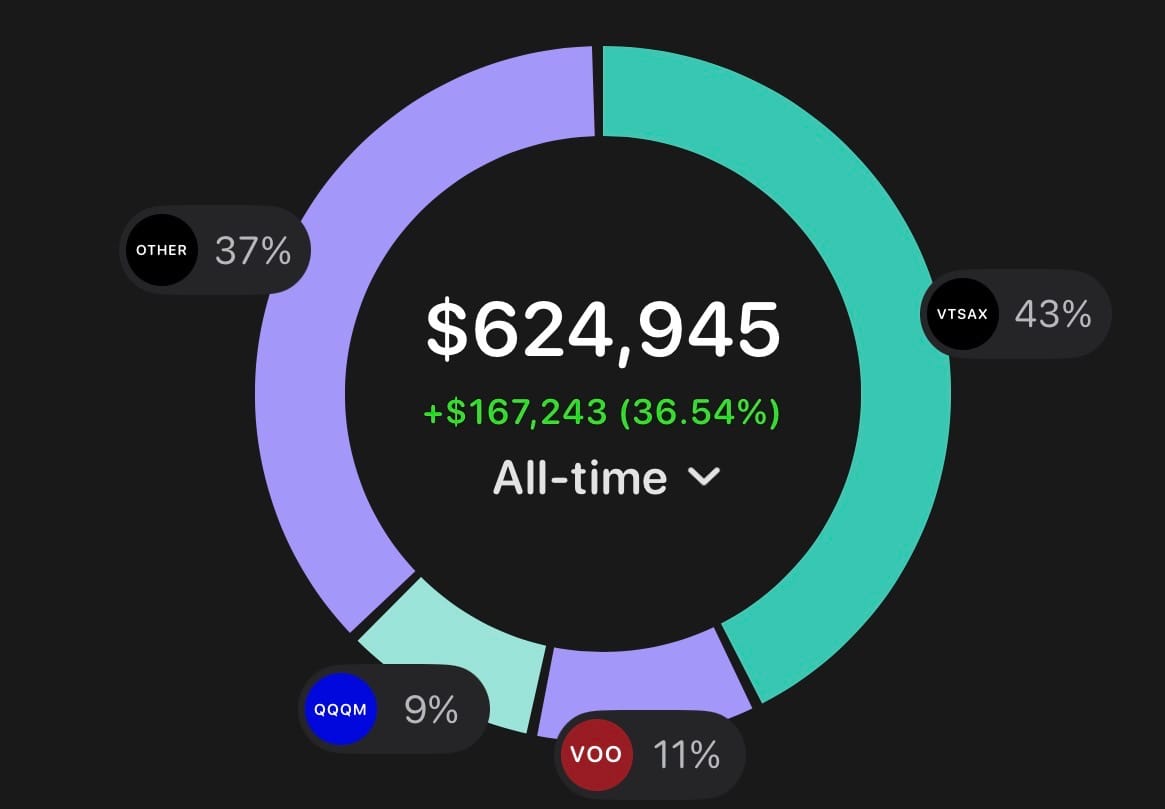
Here is my full portfolio breakdown and you can get notified every time I buy:
7. Not scaling investments over time
Starting small is smart at the beginning. But staying at the same amount for too long is where it quietly starts working against you.
At the beginning, the goal is simple: just build the habit of investing.
But once that habit is there, the next step is often ignored gradually increasing how much goes in.
The 4 M’s of growing your investments:
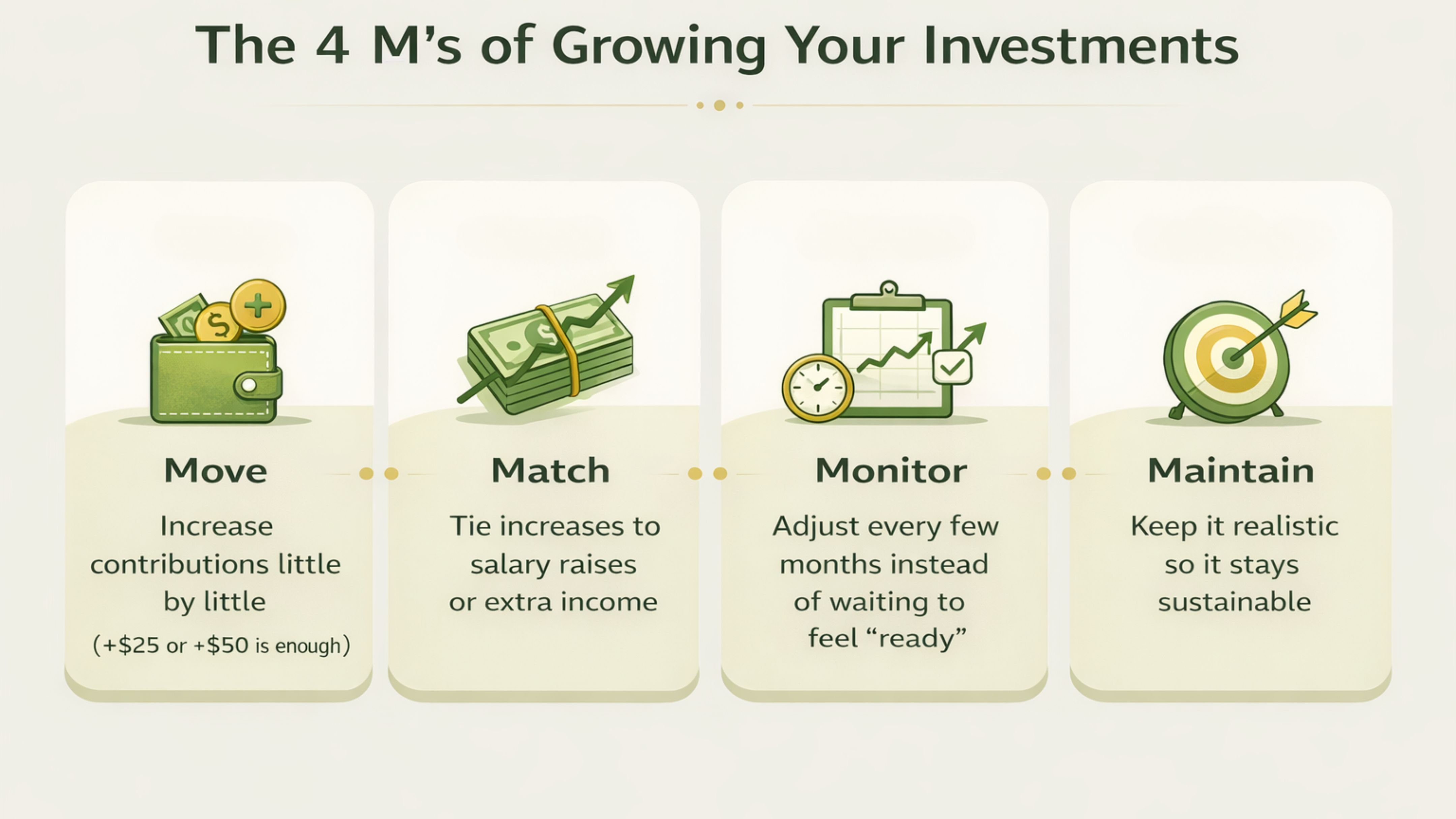
It doesn’t need to be a big jump. Just small, steady upgrades over time. The habit you build now is the foundation everything else sits on.
Every mistake on this list comes down to the same thing.
Emotion or confusion filling the space where a system should have been.
Which of these seven traps have you already fallen into? Hit reply!
I read every response :)
Where are you right now in your financial journey? |
💬Quote of the Week
Before you speak, listen. Before you write, think. Before you spend, earn. Before you invest, investigate. Before you criticize, wait. Before you pray, forgive. Before you quit, try. Before you retire, save. Before you die, give.
📉 Market Recap
Check out some of the biggest stories shaking up money, markets, and momentum this week.
👉Oil drops ~9% as Strait of Hormuz reopens
Oil prices fell sharply after Iran reopened a key global shipping route, easing supply fears and calming energy markets.
Wallet impact: Lower oil can mean cheaper gas, food, and transport costs, relieving pressure on everyday expenses.
👉Stocks hit record highs as Nasdaq posts historic win streak
The S&P 500 closed above 7,100 for the first time, while the Nasdaq posted its longest winning streak since 1992, showing strong market momentum.
Wallet impact: If you’re already invested, your portfolio likely went up. If not, it may feel like a good time to jump in but this is where people often buy at high prices.
👉Central banks are buying gold at record levels
Global central banks have been buying over 1,000 tonnes of gold annually for three straight years more than double the historical average.
Wallet impact: Rising demand for gold often signals uncertainty in the economy this is why many investors see gold as a “safe” asset during unstable times.
👉Oracle expands deal with Bloom Energy as stock surges
Bloom Energy stock jumped ~15% after Oracle expanded their partnership to support AI data centers with alternative energy.
Wallet impact: AI demand isn’t just boosting tech but it’s also driving growth in energy companies supporting it.

As of 04/19/2026
I want your honest take! Are you enjoying the market recap? |
👀 In Case You Missed It
If I had to start from $0 at 24, this is exactly what I’d do to hit $100K.
🌱3 more ways I can help build your wealth
Budget Template + Net Worth Tracker: Most budgeting apps either baby you or confuse you. This template does neither. It gives you clarity in under 10 seconds a day. I use it to track spending, savings, and net worth in one place.
My Youtube Channel: If you prefer learning visually, I walk through real-life examples, portfolio breakdowns, and beginner-friendly concepts step by step so they actually make sense.
Quick Survey (Help Me Help You): The more I understand you, the better I can guide you. It only takes 2 minutes to fill this out so I can help you create structure and build wealth with confidence.
See y’all next week 🫡
Angelo Castillo
How did you like today's newsletter? |
Disclaimer: The content of this newsletter is for informational purposes only and should not be construed as investment, legal, or tax advice. The views and opinions expressed herein are solely those of the author and do not necessarily reflect the views of any business, employer, or other entity. Investing involves risks, including the potential loss of principal. Past performance does not guarantee future results. Readers are advised to conduct their own research and consult with qualified professionals before making any investment, legal, or financial decisions. The information provided is believed to be accurate but cannot be guaranteed. The author and publisher disclaim any liability for actions taken based on the content of this newsletter. This newsletter is not an offer to buy or sell any security. By subscribing or continuing to read this newsletter, you acknowledge and accept these terms and conditions.
Some of the links are my affiliate links. If you click on these links and sign up/purchase something, I may earn a small commission at no additional cost to you. This helps support me and allows me to continue creating content for you. I only promote products and services I genuinely believe in. Thank you for your support!